
Wednesday, January 13, 2010

Is that a Problem? We need solutions
Solution comes with actions;
actions implies choices and decisions;
decisions need a rationale;
(anyway Gideon says: act immediately)
The first element of a Decision Problem are:
WHO, HOW, WHAT
Who takes decision
Who is involved in the decision process
Who is impacted by the decision
How decision are taken? (which criteria I’ll use)
What is the objective?
Sometime the objective and the method are clear (puzzle problem);
Sometime the objective is clear but the method is not (the problem);
Sometimes nothing is clear (meaning you look for trebles).
Depending on the situation we can have optimal solution (substantial rationality)
or just a satisfactory solution (Procedural rationality).
Herbert Alexander Simon (June 15, 1916– February 9, 2001) is the father of decision making theory. Baruk abba chaver! He says: i.e. it is impossible to have perfect and complete information at any given time to make a decision.
In decision-making, Simon believed that agents face uncertainty about the future and costs in acquiring information in the present. These factors limit the extent to which agents can make a fully rational decision, thus they possess only “bounded rationality” and must make decisions by “satisficing,” or choosing that which might not be optimal but which will make them happy enough
The task of rational decision making is to select the alternative that results in the more preferred set of all the possible consequences of actions. This task can be divided into three required steps: (1) the identification and listing of all the alternatives; (2) the determination of all the consequences resulting from each of the alternatives; and (3) the comparison of the accuracy and efficiency of each of these sets of consequences.
(decision, action, consequences).
The correctness of decisions is measured by two major criteria: (1) adequacy of achieving the desired objective; and (2) the efficiency with which the result was obtained. Many members of the organization may focus on adequacy, but the overall administrative management must pay particular attention to the efficiency with which the desired result was obtained.
Ok, that’s all about Simon
There are another couple of things to mention:
Getting information: be satisfied with the minimum, in this case! and think about Pareto.
Participatory approach: it helps to get better info about the problem and the possible solution
It makes the solution more acceptable by stakeholders.
There are risks
Decisions must be: Transparent; Explicit, Clear.
(anyway Gideon says: act immediately)
The first element of a Decision Problem are:
WHO, HOW, WHAT
Who takes decision
Who is involved in the decision process
Who is impacted by the decision
How decision are taken? (which criteria I’ll use)
What is the objective?
Sometime the objective and the method are clear (puzzle problem);
Sometime the objective is clear but the method is not (the problem);
Sometimes nothing is clear (meaning you look for trebles).
Depending on the situation we can have optimal solution (substantial rationality)
or just a satisfactory solution (Procedural rationality).
Herbert Alexander Simon (June 15, 1916– February 9, 2001) is the father of decision making theory. Baruk abba chaver! He says: i.e. it is impossible to have perfect and complete information at any given time to make a decision.
In decision-making, Simon believed that agents face uncertainty about the future and costs in acquiring information in the present. These factors limit the extent to which agents can make a fully rational decision, thus they possess only “bounded rationality” and must make decisions by “satisficing,” or choosing that which might not be optimal but which will make them happy enough
The task of rational decision making is to select the alternative that results in the more preferred set of all the possible consequences of actions. This task can be divided into three required steps: (1) the identification and listing of all the alternatives; (2) the determination of all the consequences resulting from each of the alternatives; and (3) the comparison of the accuracy and efficiency of each of these sets of consequences.
(decision, action, consequences).

The correctness of decisions is measured by two major criteria: (1) adequacy of achieving the desired objective; and (2) the efficiency with which the result was obtained. Many members of the organization may focus on adequacy, but the overall administrative management must pay particular attention to the efficiency with which the desired result was obtained.
Ok, that’s all about Simon
There are another couple of things to mention:
Getting information: be satisfied with the minimum, in this case! and think about Pareto.
Participatory approach: it helps to get better info about the problem and the possible solution
It makes the solution more acceptable by stakeholders.
There are risks
Decisions must be: Transparent; Explicit, Clear.
Modelling what?
.jpg)
Impact of climate change
Impact of adaptation strategies
Does not matter whether climate change is anthropogenic or not… it is a fact anyway. There are three ways to walk now: we adapt; we mitigate it; we ignore it.. (I’ll do them all together ;)
Business as usual does not require new thinking, but adaptation and mitigation strategies do and we may need modelling for that.What does a model do: it is a simplification of the system, it tells me how all the element of system moves together.
When there resources we are dealing with are scarce, that’s an economic model.
When there is a cost benefit analysis that’s an economic model.
When there are infinite resources to be allocate that’s not an economic model.
An ideal policy would combine both adaptation and mitigation.
Modelling stages:
10) measuring impact of CC on welfare;
20) measuring costs&benefits of different adaptation&mitigation strategies;
Strategies? How would you judge them?
10) effectiveness: ability to reach the goal (yes/no; %)
20) efficiency: ability to reach the goal at a minimal cost ($)
30) equity: related to resource allocation;
The chain of events in a CC model:
10) climate system dynamics or scenarios will impact on (20)
20) environmental dynamics will impact on (30)
30) social and economic dynamics will impact on (10)
apparently we always look at the changes in the system… the delta in the agricultural costs, delta in soil productivity, delta in water availability etc etc… mind the delta! Sure..
Rotmans and Dowlatabady 1995
Models have plenty of gaps, here they are in two macro groups:
10) incompleteness: we don’t know data or don’t understand relations (who doesn’t anyway?)
20) Probability: we are not certain of data and relation and there is a probability distribution attached to a certain event or estimation. Discount choice
We know a lot about costs of adaptation and mitigation we don’t know enough about their benefit. Benefits are probable, cost are certain….
Moreover many investments and many natural phenomena are not reversible, for example a dike cannot be dismantled and reused somewhere else (yet); a species extinction is even a more sad story.
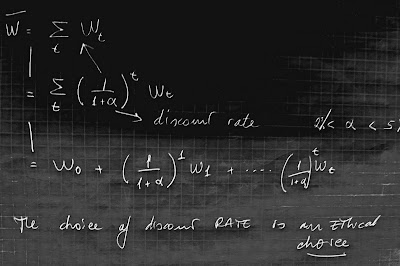
Welfare measurement and redistribution always imply ethical judgement, and also decision about..
- Inter-generations distribution (temporal distribution)
- Infra-generations distribution (spatial distribution)
Moreover, it is possible to rank welfare level in a cardinal order but it is not possible to measure how much a person or a group is better well off the another.
The following are three possible objective functions, were:
W is welfare, a is a weight, α is the interest rate..
.jpg)
.jpg)
Tuesday, December 22, 2009

.jpg)
Wednesday, October 7, 2009
Measuring precipitation in Sicily
In Sicily, precipitation measurements started in 1795, at the Ossevatorio Astronomico di Palermo (Astronomic Observatory of Palermo). In 1876 the Ufficio Centrale di Metereologia (Central Office of Meteorology) was founded. Nevertheless only in 1921 the Servizio Idrografico (Ideographic Service) became operational installing a network of of audiometric stations. The measurements were collected and regularly published in the Annali Idrologici. More recently, in 2002, a network of stations operated in remote was started, this allows real time monitoring. Since 2006 the Servizio Idrografico has changed name and is now called Osservatorio delle Acque (Waters Observatory), this is a department of the Agenzia Regionale per I Rifiuti e le Acque ARRA (Regional Agency for Water and Garbage Management).
1795 - Ossevatorio Astronomico di Palermo (Astronomic Observatory of Palermo);
1876 - Ufficio Centrale di Metereologia (Central Office of Meteorology); Regio Ufficio Centrale di Metereologia e Geodinamica, Ministero dell'Agricoltura, Industria e Commercio;
Filippo Eredia collected and published measueremnts 1918 and 1925 (Ministero dei Lavori Publlici);
1921 - Servizio Idrografico (Ideographic Service); Ministero dei Lavori Pubblici;
2006 - Osservatorio delle Acque (Waters Observatory);
Other networks belongs to:
Ufficio Centrale di Ecologia Agraria (UCEA);
Ufficio Metereologico dell'Areonautica Militare (SMAM);
Ufficio Informantivo Agrometereologico della Sicilia (SIAS);
Enti e Privati;
Subscribe to:
Posts (Atom)